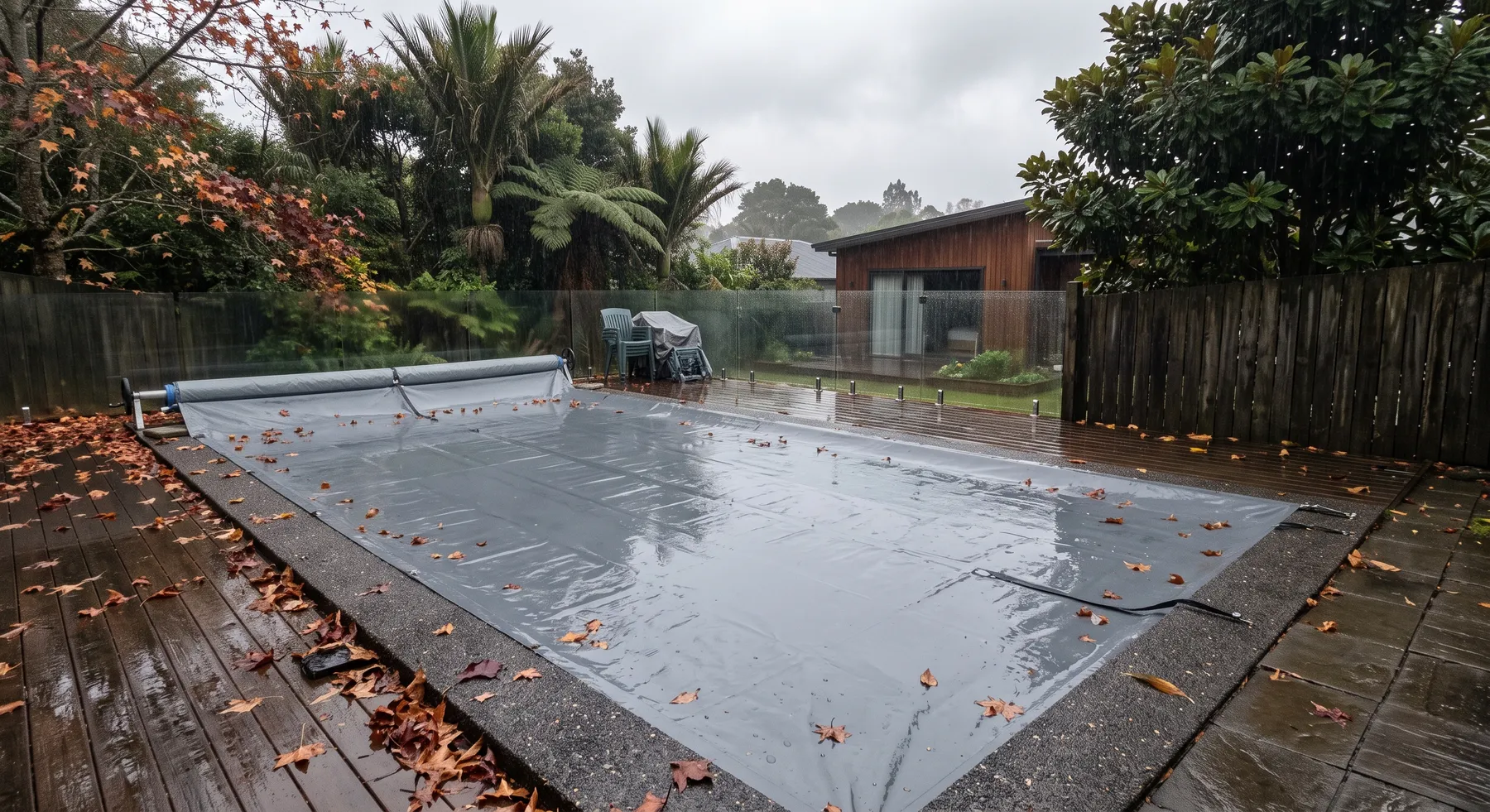
Auckland doesn’t get the brutal winters that freeze pools solid elsewhere in the world, but that’s exactly why so many pool owners get caught out. A mild, wet Auckland winter feels like it shouldn’t need much attention, and that assumption is how a perfectly healthy pool turns into a green mess by spring. Here’s what actually matters over the colder months, and what you can safely dial back.
Why Winter Pool Care Still Matters in Auckland
Auckland winters sit around 8 to 15°C on average, with plenty of rain and short bursts of sun. That’s cool enough to slow algae growth significantly compared to summer, but not cold enough to stop it altogether. Add in falling leaves from deciduous trees, wind-blown debris, and rain diluting your chemical levels, and you’ve got a pool that still needs regular, if lighter, attention.
The biggest mistake Auckland pool owners make over winter isn’t doing too little, it’s doing nothing. A pool that’s completely ignored for three months doesn’t just get a bit dirty; it can develop cloudy water, algae blooms, and scale build-up that takes real time and money to reverse in spring. Our pool maintenance checklist covers the year-round basics if you want the full picture — this guide focuses specifically on what changes over winter.
What to Keep Doing All Winter
- Run the filter, just less. 4 to 6 hours a day is usually enough in winter, down from 8 to 10 hours in summer. Your pool still needs water turnover to stay clear.
- Test chemistry every couple of weeks. A basic pool test kit measures three things — pH, chlorine, and alkalinity — and all three still drift over winter, just more slowly than in summer. A quick test every couple of weeks keeps small issues from becoming big ones.
- Keep a low chlorine level. If you test your water, aim for a free chlorine reading of 0.5 to 1 ppm (parts per million) — lower than the 2 to 4 ppm you’d want in summer, but not zero. Don’t have a test kit? A basic one from any pool shop or hardware store will tell you this in seconds.
- Clear debris regularly. Auckland’s wet, windy winters mean leaves, twigs, and grit end up in the pool constantly. A clogged skimmer basket restricts flow and stresses your pump.
- Check on the pool every two weeks minimum. Even if no one’s swimming, a five-minute visual check and test can save you a nasty spring surprise.
What You Can Ease Off On
- Reduce filter run-time. There’s no need to run it 8+ hours a day when nobody’s swimming and the winter sun isn’t strong enough to burn through your chlorine as fast.
- Skip the daily vacuum. Fortnightly is usually plenty unless you’re seeing visible debris build-up.
- Ease back on shock treatments (a one-off big dose of chlorine used to clear the water after heavy use or an algae scare). With nobody swimming and weaker winter sun, you shouldn’t need to do this nearly as often as in summer.
The One Thing That Makes the Biggest Difference
If you only do one thing differently this winter, get a pool cover. It’s the single highest-impact change you can make: it dramatically cuts evaporation, keeps debris out, reduces chemical consumption, and means far less work when spring rolls around. A well-fitted cover also has a safety benefit worth knowing about — Water Safety New Zealand notes that securing your pool between uses is one of the simplest ways to reduce drowning risk for young children, alongside compliant pool fencing. For Auckland’s rainy, leaf-heavy winters specifically, a cover pays for itself within a season or two.
Common Winter Mistakes We See in Auckland Pools
- Turning the pump off completely. This is one of the fastest ways to end up with a swamp. Water needs to keep moving, even in winter.
- Letting chlorine hit zero. Even in cool water, algae doesn’t wait for summer to start growing.
- Ignoring the pool until spring. By the time you check in, you’re often looking at a full green pool recovery rather than a quick tidy-up.
- Not accounting for rain. Heavy Auckland winter rain dilutes your chemical levels and can raise your water level enough to affect skimming. Both are worth checking after a big downpour.
Getting Ready for Spring
The good news: a pool that’s had consistent, light winter maintenance needs very little work to open up for summer. If you’ve kept the basics ticking over, our spring pool opening guide will take you through the rest. It’s also a good time to book a pool health check if your equipment hasn’t been looked at in a while, so any issues get sorted before the summer rush.
If winter has gotten away from you and you’re looking at a pool that’s more green than blue, don’t stress, it’s very fixable. Read our step-by-step green pool guide, or if you’d rather hand it to someone else entirely, Pool Pals’ regular maintenance service can pick up your pool through winter and have it summer-ready without you lifting a finger. Plans start from $88 per visit with basic chemicals included — see our full pricing for details.
Frequently Asked Questions
Should I turn my pool pump off over winter?
No, keep it running, just for fewer hours per day. Stopping circulation entirely is one of the most common causes of a green pool by spring.
How often should I test my pool water in winter?
Every two weeks is a reasonable minimum for most Auckland pools. If you notice discoloured or cloudy water, test immediately rather than waiting for your usual schedule.
Do I need a pool cover in Auckland?
It’s not compulsory, but it’s the single best investment for winter pool care here. It cuts evaporation, keeps leaves and debris out, and significantly reduces the chemical dosing you need.
Can algae grow in an Auckland pool during winter?
Yes. Auckland’s winters are too mild to stop algae growth completely, they just slow it down. A pool with no chlorine and no circulation can still turn green over winter, just more slowly than in summer.